
Italian Space Agency + bachelor’s thesis
Lunar power sizing, from requirement to mass.
A preliminary Python model for vertical solar-array and battery sizing, with a focus on the architectural consequences of energy storage.
The engineering question
A habitat’s electrical load continues through periods when its solar arrays cannot generate power. I wanted to understand how the duration of that gap, together with the battery assumptions, affects the size of the electrical power system.
During my internship at the Italian Space Agency, I assessed technologies for sustained crewed lunar operations in the context of the Multi-Purpose Habitat program. I worked closely with the program’s project manager, Simone Illiano, while reviewing ECLSS, thermal control, power, logistics, and habitat interfaces.
My contribution
I developed a preliminary parametric model in Python for vertical solar arrays and battery storage. My bachelor’s thesis extended the work to examine illumination conditions, eclipse duration, and storage assumptions.
Start from the electrical demand and the period that must be covered by storage.
Account for conversion losses, depth of discharge, and end-of-life capacity.
Combine the battery, array, PMAD allowance, and system mass margin.
Alongside the sizing work, I reviewed NASA, ESA, ASI, and industry documentation to identify technology gaps and integration constraints. I compared candidate technologies in terms of mass, power, reliability, maintainability, redundancy, and technology readiness.
A reference case with a heavy storage requirement
The reference load remains 10 kW throughout this case. The model accounts for the storage capacity needed beyond the useful energy delivered to the load.
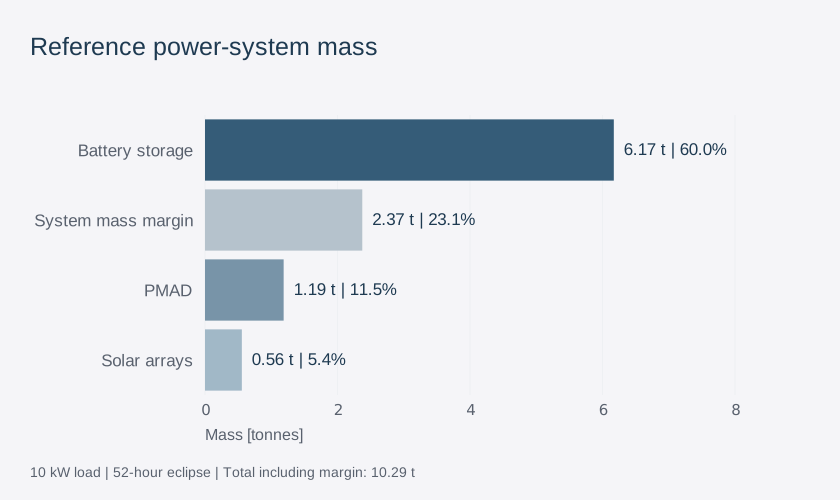
Under the study assumptions, the reference case required an estimated 6,170.7 kg of batteries. The final modeled EPS mass was 10,287.9 kg, including a 30% system mass margin applied to the pre-margin total.
Explore the reference case · 10 kW · 52 h
Where does the mass go?
The system margin adds 30% to the pre-margin total. Battery storage accounts for 60.0% of the resulting 10.29 t EPS mass. The component masses remain the same in both views.
| Contribution | Mass | Share of total |
|---|---|---|
| Battery storage | 6,170.7 kg | 60.0% |
| Solar arrays | 556.0 kg | 5.4% |
| PMAD | 1,187.1 kg | 11.5% |
| System mass margin | 2,374.1 kg | 23.1% |
| Total, including margin | 10,287.9 kg | 100% |
EPS = electrical power system. PMAD = power management and distribution. Values are rounded; the total refers to the modeled EPS, not to the full habitat.
What the result means for the architecture
Storage accounts for 60% of the total mass including margin, or about 78% before that margin. In this reference case, the battery is the largest single mass contribution by a wide margin.
That changes the question from “How large should the array be?” to “What electrical demand must we support, for how long, and under which storage assumptions?” A requirement on eclipse operation becomes a consequence for system mass.
The lesson I took from the model
The power budget is also an architecture decision. The loads required during darkness need to be understood and justified before storage sizing can be meaningful.
I explored reduced-load cases as sensitivity studies. They show how load assumptions affect sizing; they do not demonstrate that the habitat can safely operate below its 10 kW reference requirement.
The model’s scope
This is a preliminary sizing study. The parametric reference case depends on the illumination, battery, conversion-loss, and margin assumptions used in the model, and would need further validation as a spacecraft design developed.
I treated solar availability and eclipse duration as inputs to the sizing problem. My contribution was technology assessment and preliminary modeling in the MPH program context.
The work strengthened my interest in systems engineering: following a requirement through to its numerical consequences, then checking what those consequences mean for the wider habitat.